
6 reasons to visit Sparta (and not let Mystras be the only star)
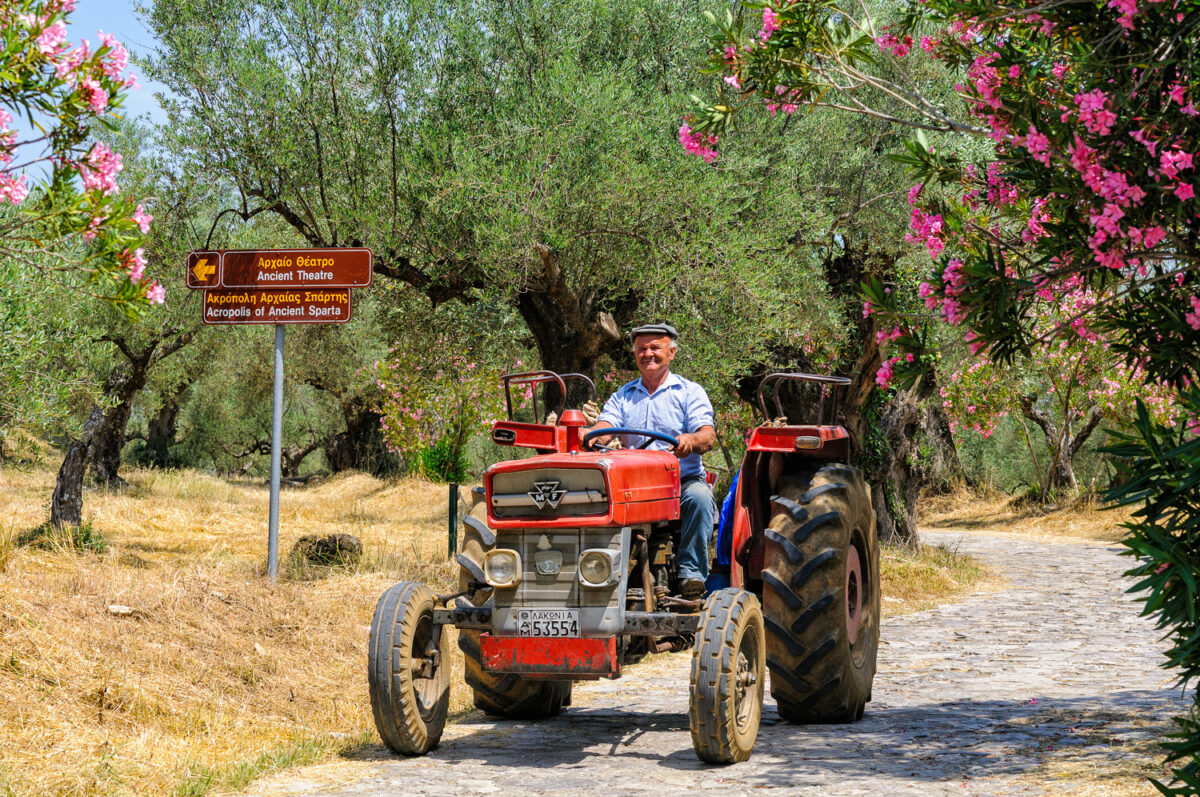
You still come across it in travel guides: the advice to skip Sparta and only visit nearby Mystras. As far as we are concerned, that is all the more reason to take a look here. Where Mystras is impressive, Sparta is alive. For the photographer and the traveler seeking the real Greece, this small town in the Eurotas Valley is a gold mine.
Here are six reasons to visit Sparta, with or without a camera.
-
Meet local life
Modern-day Sparti is located exactly on the site of the famous ancient Sparta. It is not a museum city, but a typical Greek center with an important regional function. Locals come here to shop, visit the market, or conduct banking business.
Feast your eyes in the hardware stores, where the shelves are overflowing with tools for the olive harvest. At the vegetable market, you will find yourself in a sensory experience: the scent of fresh dill, parsley, and tomatoes mingles with the buzz from the terraces. For a true Greek does not start the day without a Greek coffee or a frappé. Here, you are right in the midst of unfiltered, authentic Greek life. And if you love street photography, Sparta is a paradise.

-
The Olive Oil Museum
If you want to understand the soul of the Peloponnese, a visit to this museum is a must. The olive tree is the heartbeat of the Greek peninsula. Sparta, too, is surrounded by an endless sea of olive trees. Olives and olive oil are the engine of the local economy and Spartan oil is considered one of the best in the world. In the Olive Oil Museum, you get a fascinating picture of the production, from antiquity to the present day.
The museum also offers wonderful opportunities for detail photography: old presses, historical tools, and the gold fluid in all stages. The combination of indoor and outdoor exhibitions makes it interesting for every type of lighting.
 Open from Wednesday to Sunday, 10:00 – 18:00
Address: Othonos Amalias 129, Sparti
Website
-
The Farmers’ Market of Sparta (Laiki)
Every Wednesday and Saturday morning, the center of Sparta transforms into a colorful spectacle. Local farmers sell their harvest. You walk among piles of vegetables, fruit, and regional products – from bright orange oranges and green zucchinis to local honey and wild herbs from the mountains.
The interaction with the traders and the dynamics of the market give you an honest glimpse into the inner workings of this part of Greece.
Most vendors are open to having their portrait taken, provided you ask. A few words of Greek (or a smile) work wonders. The soft morning light between the stalls offers ideal conditions for atmospheric market photos. If you arrive a bit later, watch out for the harsh shadows!

When: every Wednesday and Saturday from 08:00 – 13:00
Location: Odós Lisandrou and side streets
-
Acropolis and Theatre of Sparta
The remains of ancient Sparta lie within walking distance of the center. Here, you stroll among centuries-old olive trees through the ruins of the city and the well-preserved theater.uitzicht over het moderne Sparta en hetview over modern Sparta and the Taygetos-gebergte vormen een imposant decor, perfect voor landschapsfoto’s met diepte.The Taygetos mountains form an imposing backdrop, perfect for landscape photos with depth.
Open daily from 08:00 to 15:30 in winter and 20:00 in summer
Free access
Website

-
Timeless mosaic art
The ancient Spartans used pebbles for their images, while the Romans later perfected the technique of the ‘tesserae’ (small stones). Beautiful examples of these have been found in and around Sparta.
You can admire this art at the House of Mosaics, the Archaeological Museum, and at Mosaic Art Greece. At the latter location, you can not only see applications, but also get started yourself.
House of Mosaics: free admission. The most important mosaics are always visible.
Archaeological Museum: open Tuesday to Sunday from 08:30 – 15:30 (closed on Mondays)

Mosaic Art Greece: open daily, times vary
-
The Menelaion
Outside Sparta, on the first hills of the Parnonas mountain range, lies a remarkable monument: the Menelaus. This is a pyramid-shaped sanctuary dedicated to King Menelaus and Queen Helen (the famous Helen of Troy). Although the pyramid-shaped temple is a ruin, the location is strategically perfectly chosen and perhaps the most beautiful experience in the region. From here, you have a magnificent view over the Eurotas Valley and the Taygetos mountains. Not many people visiting Sparta come here, so you can enjoy this fabulous place in peace and quiet.
Photography tip: Ideally, visit the Menelaion in the morning or at sunset. In the afternoon, the sun is directly overhead, causing backlighting. The soft morning light, or the sidelight when the sun has set behind the mountains, accentuates the texture of the ancient stones and bathes the Eurotas Valley in a golden glow. It is precisely at those moments, when the sharp contours of the Taygetos stand out against the sky, that you feel the mystique of this place most strongly. It is the moment when the camera can be set aside for a moment and you simply immerse yourself in the grandeur of the landscape.

Access: Open 24/7
Route: Follow the narrow path from the ring road (Eparchiaki Odos Spartis-Gythiou) to the small church. From there, walk up the path to the hilltop.
Website
In short: don’t be misled by guides who skip Sparta. It is precisely the combination of lively street life, rich history, and beautiful landscapes that makes Sparti an indispensable stop for any (photo) trip on the Peloponnese.
A few days at Sparta? Xirokambi is a wonderful base.
You can entertain yourself for a few days in Sparta alone. And that is without having been to Mystras or gone hiking in the Taygetos mountains. The charming village Xirokambi. It is a wonderful base for excursions in the Sparta Valley. Located 13 km south of Sparta, this village offers good accommodation, fantastic food, and a charming square. You can reach Sparta quickly by car, but you can also take the local bus or taxi.
